Spurious, substandard, falsified, adulterated: what DRAP's alert words mean
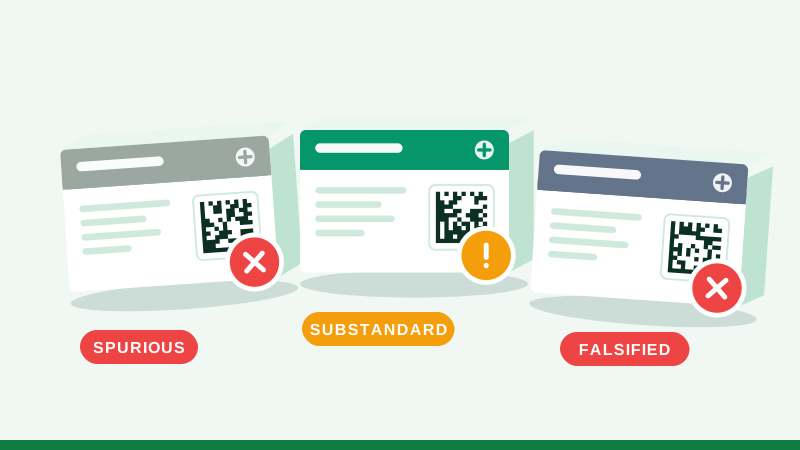
A spurious or falsified medicine is a fake that pretends to be something it is not. A substandard medicine is real but fails quality standards. DRAP alerts use these words, plus adulterated, misbranded and unregistered, with legal meanings set out in the Drugs Act, 1976. Here is what each means for you.
| Term | Plain meaning | Typical example | What to do |
|---|---|---|---|
| Spurious | Imitates or passes off as another product, or claims a maker that did not make it | Tablets in a copied brand box with no active ingredient | Do not use. Report. |
| Falsified | WHO's term for deliberately misrepresenting identity, composition or source; used alongside "spurious" | Fake vaccine vials circulating internationally | Do not use. Report. |
| Substandard | From an authorised maker but fails specifications | Too little active ingredient, failed dissolution, contamination | Stop using that batch. Return it. |
| Adulterated | Contains a harmful or wrong substance, or was made or stored in conditions that may contaminate it | Contaminated syrup or eye drops | Do not use. Seek care if you have symptoms. |
| Misbranded | Label is false, misleading or missing required information | Wrong strength printed, missing registration number | Return and ask for a correctly labelled pack. |
| Unregistered | Sold without DRAP registration | Imported products sold without approval | Avoid. Ask for a registered alternative. |
Why the difference matters
For a patient the advice is the same: do not use the product. The difference matters for how worried to be about other packs. A substandard batch is usually a one-off manufacturing failure limited to listed batch numbers, so other batches of the same brand are typically fine. A spurious product is a criminal copy that can carry any batch number, so for a few weeks after an alert it is worth scanning every pack of that brand carefully.
Who decides
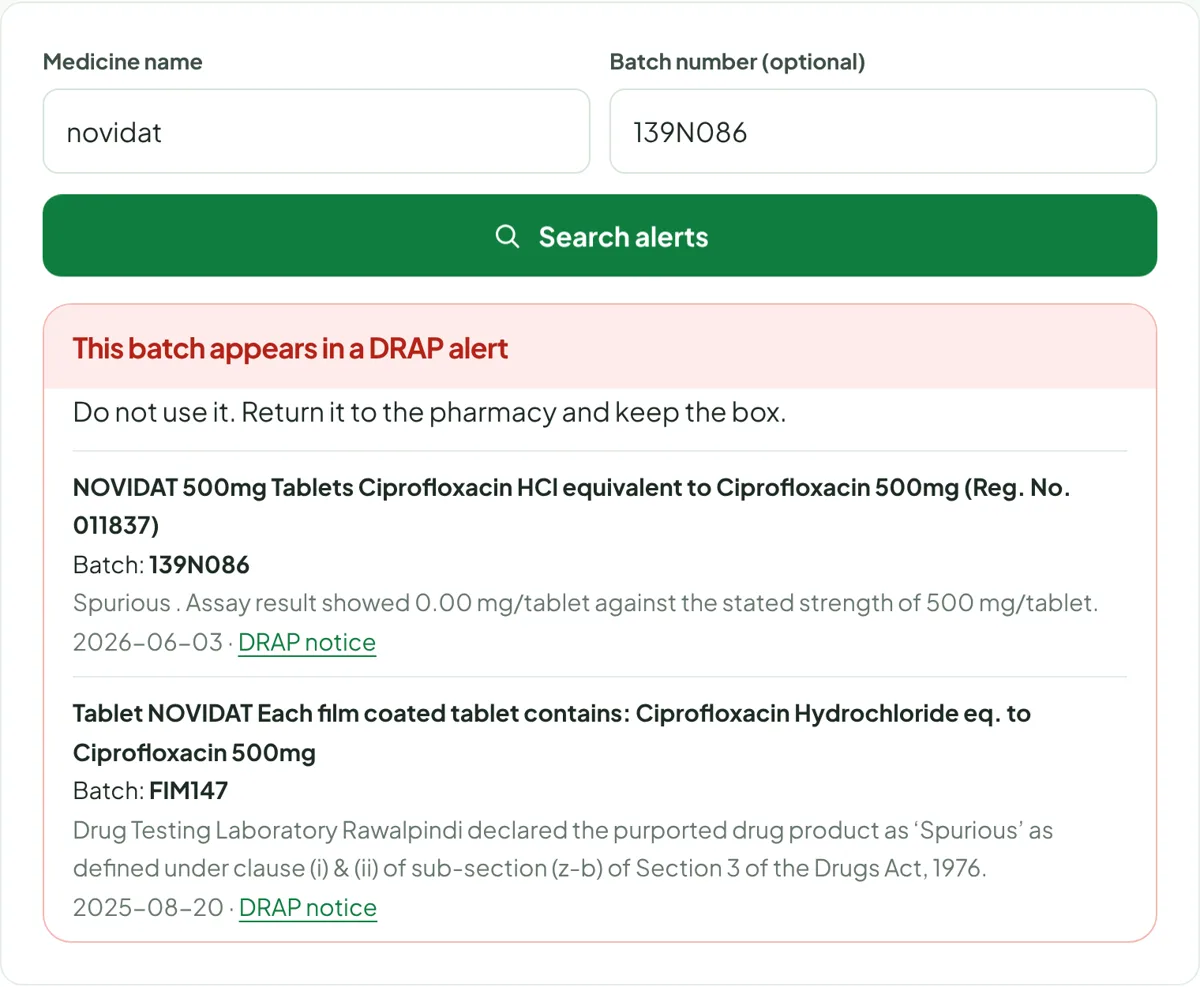
Samples are tested by federal and provincial drug testing laboratories, such as the Central Drugs Laboratory in Karachi and the Drug Testing Laboratories in each province. When a sample fails, DRAP publishes an alert naming the product, batch and finding. You can search every alert since 2021 in our recall tool.
Where track and trace fits in
Testing catches problems after they reach the market. Mehfooz Dawa adds a check at the point of sale: a spurious pack either has a serial that is not in the system or one copied from a real pack. Scanning gives you a chance to catch it before you take it.
Real examples from DRAP's alerts
The terms become clearer with cases. All of these come from DRAP's published alerts, which you can search in our recall tool.
| Finding | Classified as | What it tells you |
|---|---|---|
| Tablets labelled as a 500 mg ciprofloxacin brand containing 0.00 mg of the drug (June 2026) | Spurious | A complete fake in copied packaging |
| Dydrogesterone tablets in which no active ingredient was detected (April 2026) | Spurious | Fakes reach pregnancy-related medicines too |
| Anti-D injection and influenza vaccine batches found to be falsified (2026) | Falsified | Injectables and biologicals are targets |
| Disposable syringes failing the auto-disable test that prevents reuse (2026) | Substandard | Genuine product, real manufacturer, failed a quality test |
| Eye spray and mouthwash declared adulterated, substandard, spurious and unregistered (November 2026) | Several at once | One product can break more than one rule |
| Products declared unregistered by the Central Drugs Laboratory, Karachi (November 2026) | Unregistered | Sold without DRAP approval |
Counterfeit, fake, nakli, jali: the everyday words
Most people say "fake medicine", "nakli dawa" or "jali dawa". The law uses narrower words, and they overlap.
| Everyday word | Closest legal or WHO term |
|---|---|
| Fake, nakli, jali, duplicate | Spurious; falsified; counterfeit |
| Weak, "doesn't work", ghatiya | Substandard |
| Contaminated, milawati | Adulterated |
| Wrong label, ghalat label | Misbranded |
| Smuggled, "imported without registration" | Unregistered |
The World Health Organization groups these as "substandard and falsified medical products", or SF products, and estimates that around one in ten medical products in low- and middle-income countries falls into that category.
Why the cause differs, and why it matters
- Spurious and falsified products are made by criminals for profit. They copy well-known, fast-selling or expensive brands, and they are deliberate.
- Substandard products usually result from poor manufacturing control: a wrong mix, a failed process, unsuitable raw material. The maker is real and identifiable, and the problem is confined to particular batches.
- Degraded products start genuine and are spoiled by heat, humidity or age in the supply chain or at home. A test may show them as substandard even though the factory did nothing wrong. Good storage prevents this.
Effects on patients
The health effect depends on what is actually in the pack:
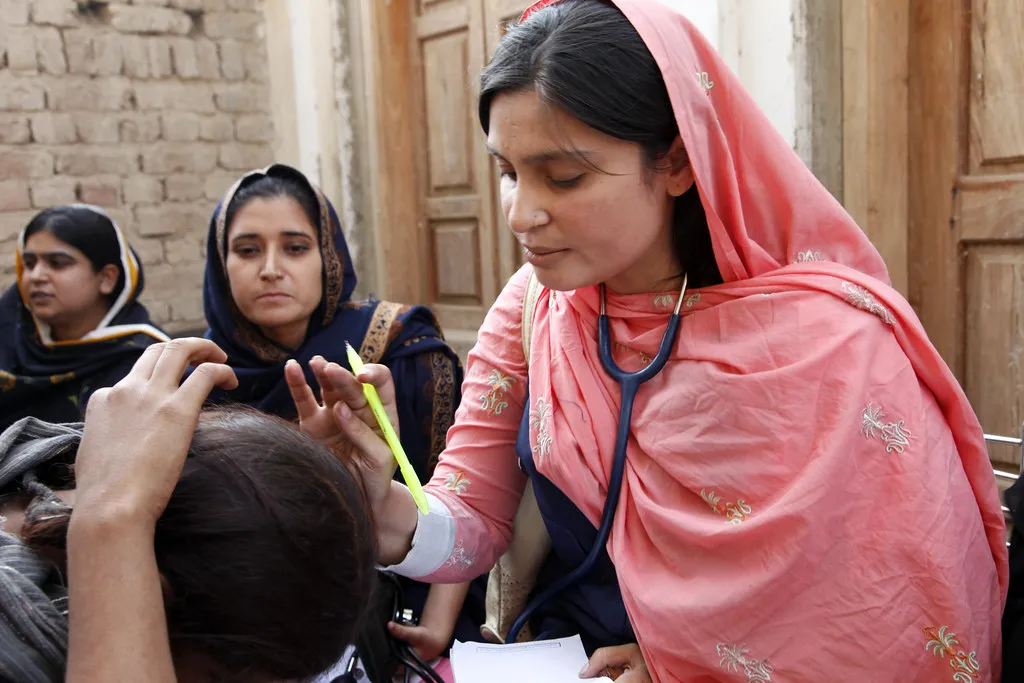
- No active ingredient: the condition goes untreated. For infections, epilepsy, diabetes or heart disease this can be dangerous within days.
- Too little active ingredient: partial effect, relapse, and for antibiotics, resistance. See fake antibiotics and resistance.
- Wrong or extra ingredient: unexpected side effects or interactions.
- Contamination: infections or poisoning, especially with injections, eye drops and syrups.
How to protect yourself against each kind
| Risk | Best defence |
|---|---|
| Spurious / falsified | Scan the square code; buy from licensed pharmacies; avoid prices far below MRP |
| Substandard batch | Search the batch in recall alerts |
| Adulterated | Check seals; avoid loose or repackaged products |
| Misbranded | Read the label carefully; compare with your prescription |
| Unregistered | Look for a DRAP Reg. No.; check it in the registration search |
| Degraded | Store correctly; do not buy from hot stalls or cars |
What happens after a product is classified
Once a laboratory declares a sample spurious, substandard or adulterated, DRAP publishes an alert naming the product, batch and claimed manufacturer, and asks its field offices and the provincial drug control departments to remove the product from the market. For a substandard batch the genuine manufacturer is usually told to recall it. For a spurious product there is no genuine batch to recall, so inspectors search the supply chain to confiscate the fakes and trace their source. Patients are advised to stop using the product and to report any problems.
These definitions come from the Drugs Act, 1976. Social media lists of "banned" medicines often mix the terms up; see banned medicines in Pakistan for what each status really means.
Questions people ask
Is substandard medicine the same as fake medicine?
No. A substandard medicine is made by a real, authorised manufacturer but fails a quality test, for example it has too little active ingredient or dissolves too slowly. A spurious or falsified medicine deliberately pretends to be a product it is not.
What does "misbranded" mean?
The label is false or misleading in some way, such as a wrong name, missing information or claims it should not make, even if the contents are otherwise acceptable.
What is an unregistered drug?
A product sold in Pakistan without registration from DRAP. It has not been assessed for quality, safety and effectiveness here, so it should not be on sale, even if the same product is legitimate in another country.
Fake medicine kya hai?
Fake ya nakli dawa woh hai jo kisi asli dawa ki naqal ho, jis mein dawa ka asal juz kam ho, bilkul na ho, ya koi aur cheez mili ho. Qanooni zubaan mein ise spurious kehte hain.
What is a counterfeit medicine?
A product that deliberately copies the label, packaging or appearance of another manufacturer's medicine so that buyers mistake it for the real thing. It overlaps with the legal term "spurious".
Is expired medicine the same as substandard?
Not exactly. An expired medicine has passed the date until which quality is guaranteed. It may still test within specification, or may have degraded. Either way it must not be sold or used.
Is a substandard medicine dangerous?
It can be. A medicine with too little active ingredient may fail to treat the illness, and one that dissolves poorly may not be absorbed. If your batch is named as substandard, stop using it and ask your pharmacist for a pack from another batch.
Who tests medicines in Pakistan?
Federal and provincial drug testing laboratories, such as the Central Drugs Laboratory in Karachi and the provincial Drug Testing Laboratories. Their findings are the basis of DRAP's alerts.