Banned medicines in Pakistan: what “banned” really means and how to check
"Banned" is not one official list in Pakistan. A medicine may not be sold if it is unregistered, if its registration has been suspended or cancelled, or if its batch has been recalled or declared spurious or substandard by DRAP. The practical check is to search the product and batch in DRAP's alerts.
Four things people mean by "banned"
| Situation | What it means | Covers |
|---|---|---|
| Unregistered | Never approved by DRAP for sale in Pakistan | The whole product |
| Registration suspended or cancelled | DRAP has withdrawn approval, for safety, quality or compliance reasons | The whole product from that company |
| Recalled | Specific batches ordered off the market, usually after a failed test | Named batches only |
| Spurious or falsified | Fake product found in the market | The fake, not the genuine brand |
Some medicines are not banned but controlled: strong painkillers and sedatives, for example, are legal only with a prescription and under stricter record-keeping.
What DRAP's alerts contain
Our index of DRAP's alerts since 2021 holds 349 notices: 138 recalls, 94 about substandard products, 92 about spurious or falsified products and 7 specifically about unregistered products. Each names the product, the maker and usually the batch numbers.
How to check a medicine
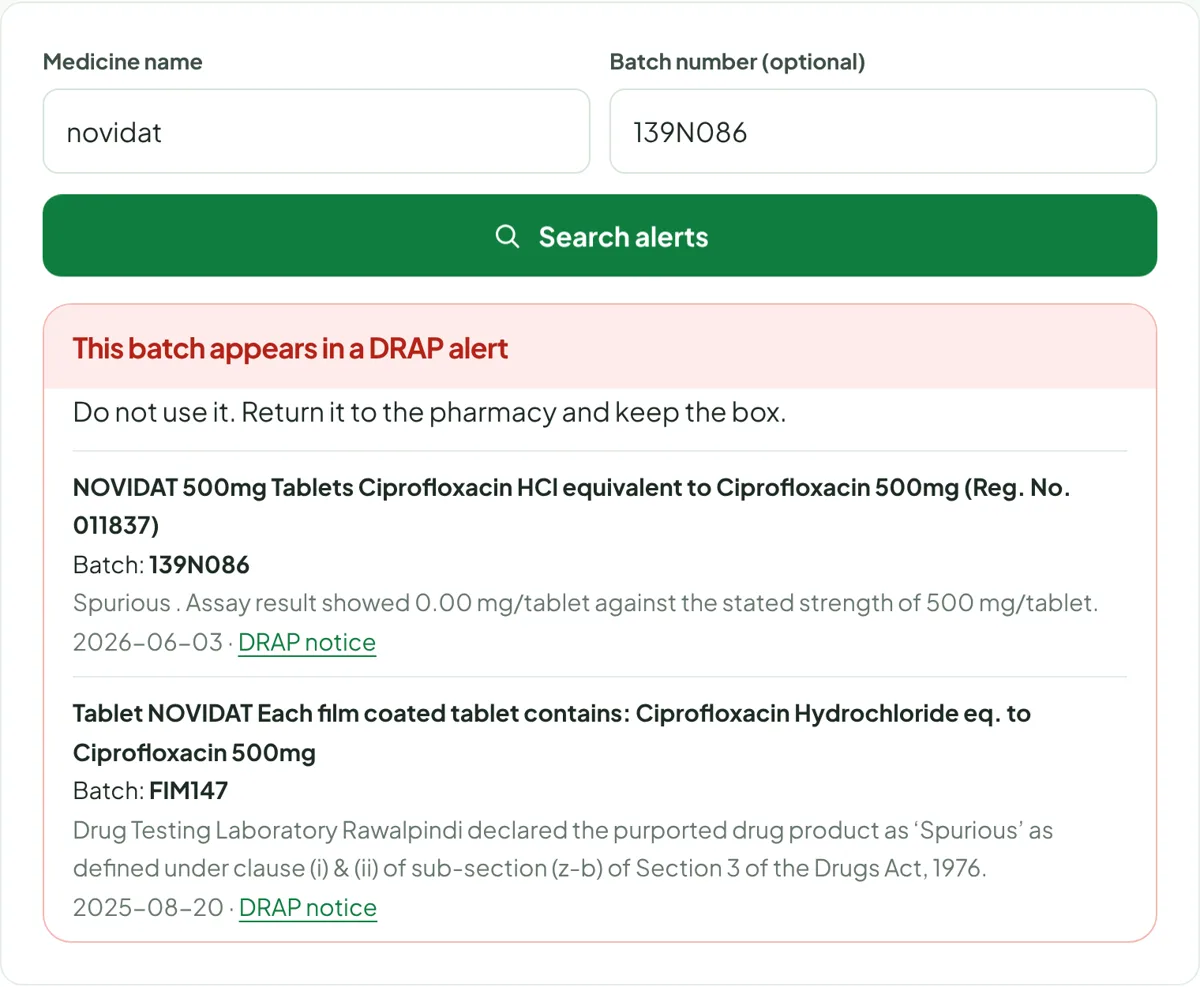
- Search recallsEnter the medicine name and batch number in our DRAP recall search. A batch match means do not use it.
- Confirm it is registeredLook it up in the DRAP price and registration search and compare the registration number with the pack.
- Scan the packScan the square code. The result reports recalled and flagged packs.
Why a famous brand can appear in an alert
Seeing a well-known brand in an alert does not mean the brand is banned. Most such alerts are about fake copies of the brand, or about one failed batch. The genuine product from other batches remains legal. Read the alert's wording: "spurious" or "falsified" points to a fake; "substandard" with batch numbers points to specific genuine batches. Our guide to these terms explains the difference.
Be careful with lists on social media
Lists of "banned medicines" shared on WhatsApp and Facebook are often copied from other countries, out of date or simply wrong. Stopping a prescribed medicine because of such a list can be harmful. Check DRAP's own notices, and ask your doctor or pharmacist before changing treatment.
Banned, recalled or just unavailable?
A medicine you cannot find is not necessarily banned. It may be in short supply, discontinued by the company, or awaiting a new price. Here is how to tell the situations apart.
| What you notice | Most likely reason | Where to check |
|---|---|---|
| A pharmacy says a brand is "banned" | Could be a recall of certain batches, a registration action, or a misunderstanding | Recall search; ask for the DRAP notice |
| No pharmacy has the medicine | Shortage or discontinuation | Shortage guide |
| A WhatsApp list names your medicine | Often outdated, foreign or false | DRAP's own alerts |
| A product is sold only online, "imported" | Possibly unregistered | Look for Reg. No.; registration search |
| Your batch number appears in an alert | Recalled or spurious batch | Stop using; return; report |
Reading a recall alert in two minutes
- Look at the alert typeRecall, substandard, spurious, unregistered.
- Find the product tableProduct name, batch number, claimed manufacturer and remarks.
- Compare with your packSame name, same strength, same batch? Then it applies to you.
- Read the adviceDRAP alerts close with advice for healthcare professionals and consumers, usually to stop using the product and report problems.
Withdrawn medicines
Occasionally a regulator decides that a medicine's risks outweigh its benefits for some or all uses, and restricts or withdraws it. Such decisions are made by DRAP and published as notices. If you take a medicine affected by such a decision, do not stop it suddenly; talk to your doctor about an alternative, because stopping abruptly can be riskier than continuing for a short time.
Banned medicine kaise check karein
Pakistan mein "banned medicines" ki koi ek sarkari list nahin. Dawa ka naam aur batch number hamare recall search mein likhein. Agar aap ka batch kisi alert mein ho to dawa istemal na karein. Dabbay par DRAP registration number zaroor dekhein. WhatsApp par aane wali liston par bharosa na karein aur doctor se pooche baghair dawa band na karein.
Medical devices and health products in alerts
Not every alert is about tablets. DRAP's alerts also cover medical devices, such as disposable syringes that failed the auto-disable test designed to stop reuse, and health products such as eye sprays and mouthwashes declared adulterated or unregistered. The same search works for these: type the product name and, if you have it, the batch or lot number.
If you have already used a recalled or spurious product
- Stop using itKeep what remains with its pack.
- Talk to your doctorEspecially if your condition has not improved or you have new symptoms. You may need a replacement medicine without a gap.
- Return or reportReturn unused stock to the pharmacy and, if harm occurred, file a side-effect report.
Questions people ask
Is there an official list of banned medicines in Pakistan?
There is no single "banned list" for the public. What exists are DRAP's registration records, which show what may be sold, and DRAP's recall and rapid alerts, which name specific products and batches that must not be sold or used.
How do I know if my medicine is banned or recalled?
Search its name and batch number in DRAP's recall alerts. If the product is registered and your batch is not in any alert, it is not subject to a recall.
Is an unregistered medicine banned?
A medicine that is not registered with DRAP may not legally be sold in Pakistan, even if it is legitimate in another country. DRAP alerts regularly name unregistered products found in the market.
A medicine was banned abroad. Is it banned here too?
Not automatically. Each country's regulator decides separately. If DRAP withdraws a product or restricts it, it issues its own notice.
Can a recalled medicine come back?
A recall usually covers named batches. Other batches of the same product that pass testing stay on sale, and the product continues unless its registration is suspended or cancelled.
Is there a DRAP list of banned medicines?
DRAP does not publish one consolidated banned list for the public. It publishes recall and rapid alerts, and registration decisions, which together tell you what must not be sold.
Can pharmacies sell recalled batches?
No. Recalled batches must be removed from sale. If you are sold one, return it and report the shop.
Kya mashhoor brand bhi ban ho sakti hai?
Aksar alert asal brand ke bajaye uski nakal ya kisi khaas batch ke baare mein hota hai. Apna batch number milayein; doosre batch aam tor par theek hote hain.
Are banned medicines abroad automatically banned in Pakistan?
No. Each regulator decides for its own market. DRAP issues its own notices when it restricts or withdraws a product.
Do recalls apply to hospital stock too?
Yes. Recalls apply throughout the supply chain, including hospitals, distributors and pharmacies.
How often does DRAP publish alerts?
Regularly. Our index holds 349 alerts from July 2021 to November 2026, with more each year. The newest are checked live on our recall page.