The Drugs Act, 1976: what Pakistan's medicine law says, in plain English
The Drugs Act, 1976 is Pakistan's core medicine law. It controls who may make, import, store, distribute and sell drugs, defines what counts as a spurious, substandard, adulterated or misbranded drug, and makes dealing in them an offence. DRAP, created in 2012, administers much of it at the federal level.
This is a plain-language overview to help you understand DRAP alerts. It is not legal advice; for a legal matter, read the official text and consult a lawyer.
What the Act covers
- Registration: drugs must be registered before they can be manufactured or sold.
- Licensing: manufacturing, import and sale require licences.
- Quality: drugs must meet the standards declared at registration.
- Labelling and advertising: rules on what must appear on the label and what claims may be made.
- Inspection and testing: powers for drug inspectors to inspect, take samples and seize stock, and for laboratories to test them.
- Offences and penalties: for dealing in spurious, substandard, adulterated, misbranded or unregistered drugs.
The definitions you see in DRAP alerts
DRAP alerts cite sections of the Act, usually Section 3, which contains the definitions. When an alert says a sample was declared "spurious as defined in Section 3", it is applying the Act's legal meaning. Our guide to spurious, substandard and falsified explains each term without the legal wording.
Who enforces it
Enforcement is shared. DRAP handles registration, licensing of manufacturers and importers, pricing and national alerts. Provincial governments license pharmacies and distributors and employ drug inspectors, and provincial drug courts hear many cases under the Act.
How it connects to Mehfooz Dawa
The Act makes selling a spurious drug an offence; track and trace makes it much harder to do without being caught. A pack that fails a scan and turns out to be fake becomes evidence that inspectors can trace back up the supply chain. That is why reporting matters.
How the Act is laid out
You do not need to read the Act to protect yourself, but knowing its shape makes DRAP's notices far easier to follow. In broad terms it moves from definitions, to who is in charge, to what is forbidden, to what happens to offenders.
| Part of the Act | What it deals with | Where you meet it |
|---|---|---|
| Definitions (Section 3) | What counts as a drug, and the meanings of adulterated, counterfeit, misbranded, spurious and substandard | Quoted in almost every DRAP rapid alert |
| Licensing and registration | Licences to manufacture, and registration of each drug before sale | The Reg. No. and manufacturing licence number on your pack |
| Boards and laboratories | Expert boards, quality control boards, drug testing laboratories and government analysts | "Declared substandard by the Drug Testing Laboratory" |
| Inspectors | Appointment and powers of drug inspectors: enter, inspect, sample, seize | Raids and sealed shops in the news |
| Prohibitions (Section 23) | What may not be imported, made or sold | The offence a seller of fake medicine commits |
| Penalties (Section 27) | Imprisonment and fines for each kind of offence | Court outcomes |
| Drug courts | Special courts that hear cases under the Act | Where prosecutions go |
What the Act prohibits, in everyday words
Section 23 is the heart of the law for patients. Put simply, nobody may import, manufacture for sale, or sell:
- a spurious drug, meaning a fake or an imitation passed off as another product;
- a counterfeit drug, one that copies another maker's label or appearance;
- an adulterated drug, contaminated or made in conditions that could make it harmful;
- a substandard drug, which does not meet its specifications;
- a misbranded drug, with a false or misleading label;
- an unregistered drug, or one made without the required licence;
- a drug after its expiry date, or in breach of its registration conditions.
The same part of the law covers selling without a proper warranty or record, and obstructing an inspector. Advertising of medicines is also controlled, which is why prescription medicines are not advertised to the public the way soft drinks are.
Penalties
The Act sets imprisonment and fines that scale with the seriousness of the offence. Dealing in spurious drugs carries the heaviest punishment, because a fake can kill; offences such as selling a substandard or misbranded product, or breaking licence conditions, carry lighter but still criminal penalties. Stock can be seized and forfeited, and licences suspended or cancelled. For the exact terms, read the current text of the Act, since the figures have been amended over the years.
Rules made under the Act
The Act gives the framework; detailed requirements sit in rules. Two matter most to anyone holding a medicine pack:
- The Drugs (Labelling and Packing) Rules, 1986 say what must appear on a pack. In June 2026 they were amended by S.R.O. 963(I)/2026 to add the 2D barcode and serial number, mandatory for products made or imported from 9 October 2026. See medicine label rules and the track and trace rule.
- Licensing, registering and advertising rules set the conditions for factories and for getting a product approved.
The 1976 Act and the DRAP Act, 2012
People often ask which law is "the" drug law. Both are. The Drugs Act, 1976 contains the substantive rules and offences. After health was devolved to the provinces in 2010, a federal regulator was needed for the functions that have to be national, such as registration, licensing of manufacture, import and export, and pricing. The DRAP Act, 2012 created that regulator and adopted the 1976 Act's machinery. Provinces kept control of sale and distribution, which is why your local medical store is inspected by a provincial drug inspector. More on the split is in what is DRAP?
Reading a DRAP alert with the Act in mind
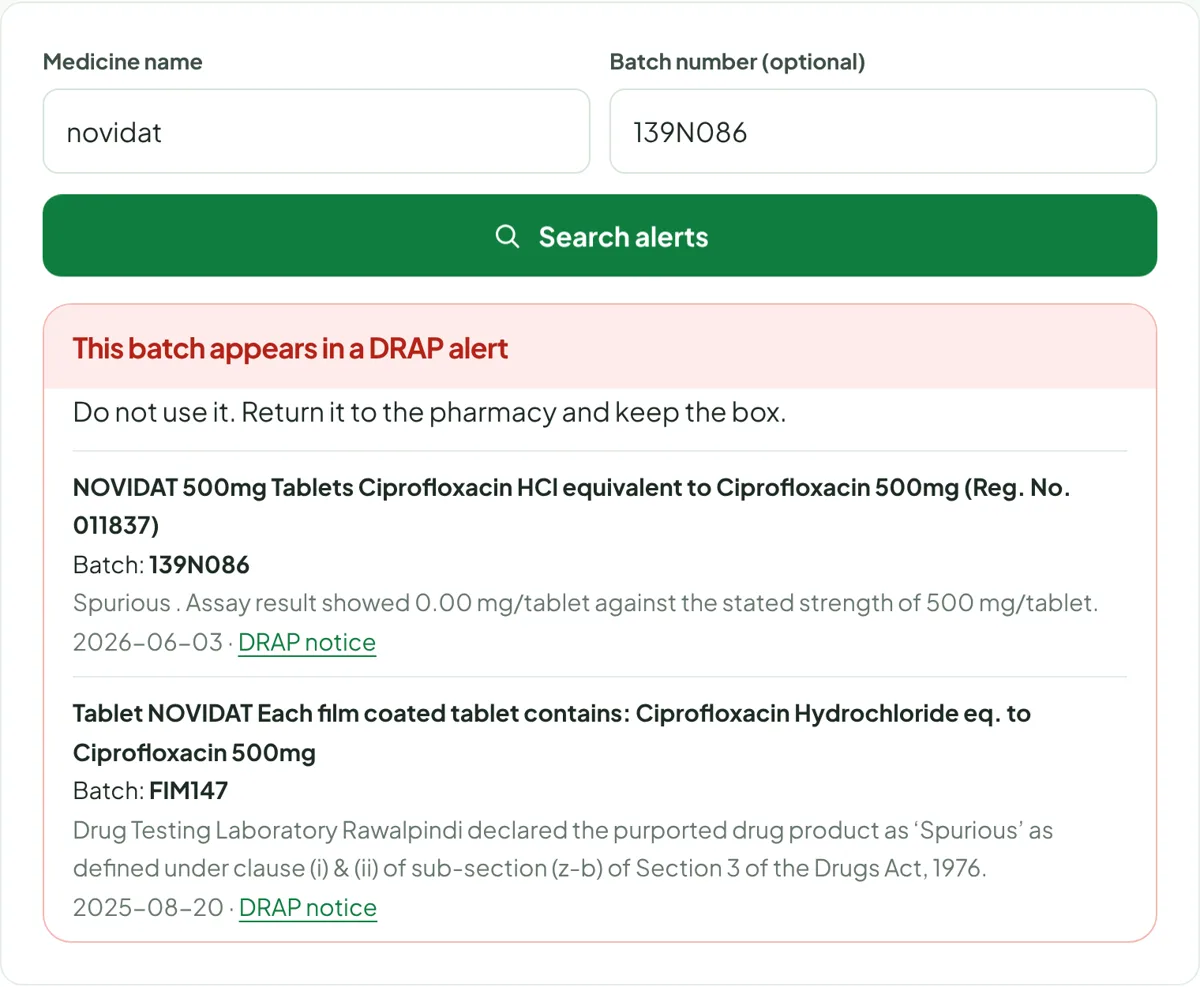
Here is how a typical alert reads: a Drug Testing Laboratory "has declared the samples of the below-mentioned drug products as adulterated, substandard, spurious and unregistered as defined in Section 3 … and Section 23 of the Drugs Act, 1976". Broken down:
- "Declared by the laboratory"A government analyst tested a sample taken from the market. This is evidence, not rumour.
- "As defined in Section 3"The words are being used in their legal sense.
- "Section 23"Selling or making that product is an offence.
- The tableProduct, batch, claimed manufacturer and remarks. That is the part to compare with your pack.
You can search every such alert since 2021 in our recall tool.
What the law means for you as a buyer
- You are entitled to a registered, in-date, correctly labelled medicine at no more than the printed price.
- You may ask for a receipt, and a careful seller will give one.
- If you are sold a fake, expired or unregistered product, the seller may have committed an offence, and you can complain to DRAP.
- Keep the pack and receipt: they are the evidence an inspector needs.
Questions people ask
What is the Drugs Act 1976?
The main federal law that controls the import, export, manufacture, storage, distribution and sale of drugs in Pakistan. It defines spurious, substandard, adulterated and misbranded drugs and sets out offences and penalties.
Is the Drugs Act 1976 still in force?
Yes. It has been amended several times and works alongside the DRAP Act, 2012, which created DRAP, and the rules made under both laws.
Who enforces the Drugs Act?
DRAP at the federal level for registration, licensing of manufacturing and import, and related matters, and provincial drug control departments and drug inspectors for sale and distribution, including pharmacies.
What is Section 23 of the Drugs Act 1976?
Section 23 lists what is prohibited: importing, manufacturing for sale or selling spurious, counterfeit, adulterated, substandard, misbranded, unregistered or expired drugs, among other things. DRAP alerts usually cite it alongside the definitions in Section 3.
What is the punishment for selling fake medicine in Pakistan?
The Drugs Act, 1976 provides imprisonment and fines, with the most severe penalties for spurious drugs. Stock can be seized and licences cancelled. The exact terms are in the current text of the Act.
Where can I get the Drugs Act 1976 PDF?
The official text of the Drugs Act, 1976, the DRAP Act, 2012 and the rules made under them are published in the legislation section of DRAP's website, dra.gov.pk.
What are drug courts?
Special courts set up under the Drugs Act to hear cases about drug offences, such as the manufacture or sale of spurious or substandard medicines.
What powers does a drug inspector have?
Under the Act an inspector can enter and inspect premises where drugs are made, stored or sold, take samples for testing, and seize stock and records where an offence is suspected.