What is DRAP? Pakistan's medicine regulator explained

DRAP, the Drug Regulatory Authority of Pakistan, is the federal body that decides which medicines can be sold in Pakistan, who can make or import them, and what happens when something goes wrong. It was created by the DRAP Act, 2012, and enforces the Drugs Act, 1976. Mehfooz Dawa is one of its programmes.
What DRAP does
| Function | What it means for you |
|---|---|
| Registration | Every medicine legally sold here has a DRAP registration number printed on the pack. |
| Licensing | Manufacturers and importers must be licensed and inspected. |
| Pricing | Administers the drug pricing policy; the maximum retail price is printed on the pack. |
| Quality control | Coordinates testing of market samples through drug testing laboratories. |
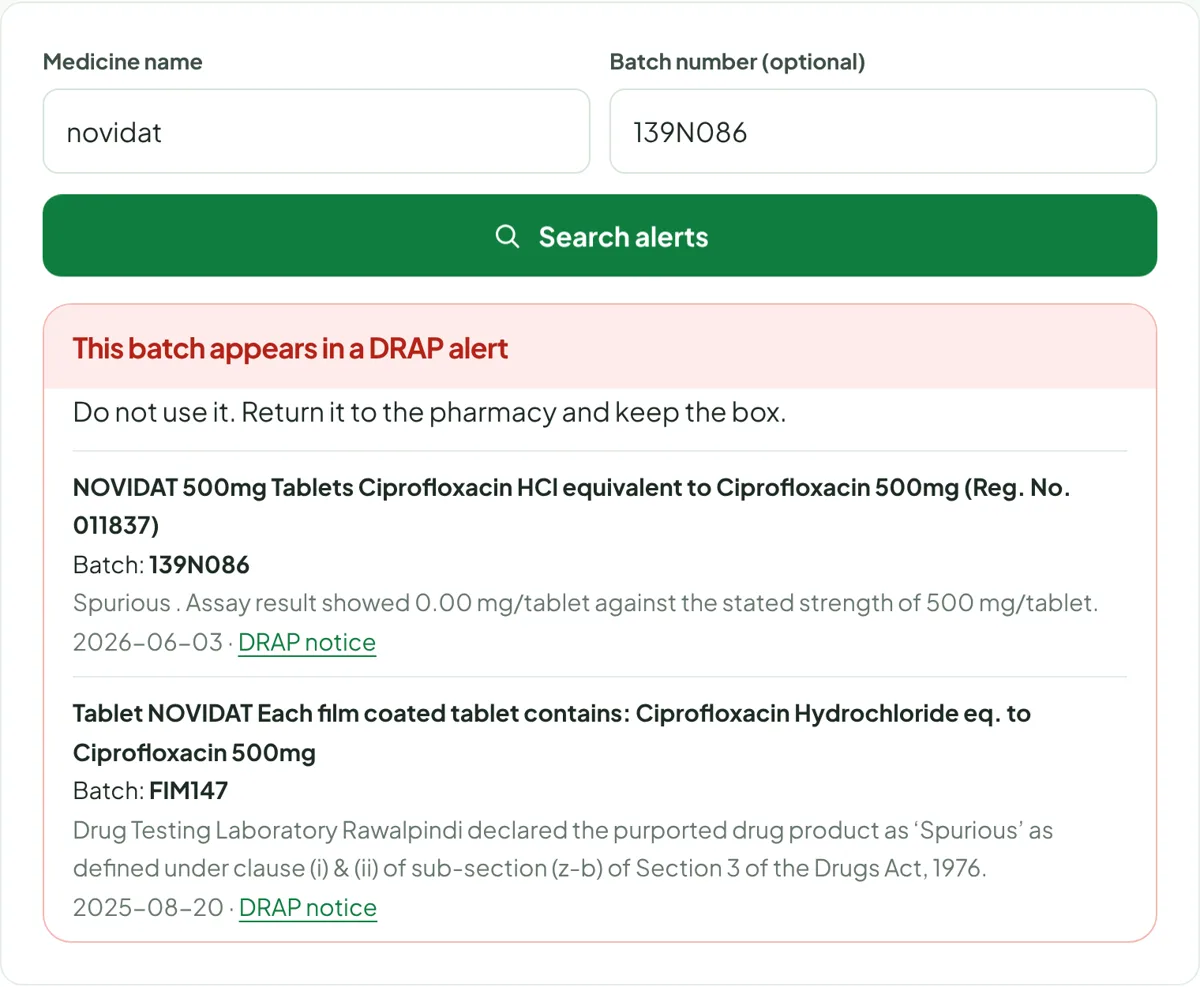
| Recalls and alerts | Publishes recall and rapid alerts for failed or fake products. Search them here. |
| Pharmacovigilance | Collects reports of side effects to spot safety problems. |
| Track and trace | Runs Mehfooz Dawa, so packs can be verified by serial number. |
What DRAP does not do
Retail pharmacies are licensed and inspected mainly by provincial drug control departments, which also employ drug inspectors who take market samples. So a complaint about a particular shop may be handled provincially, while a problem with a product or batch goes to DRAP.
DRAP and Mehfooz Dawa
Mehfooz Dawa is DRAP's track and trace programme. Manufacturers print a GS1 DataMatrix on each pack and upload the serial numbers; patients and pharmacies can then check a pack against that record. Read our full Mehfooz Dawa guide or how to check a medicine.
Official contact points
DRAP's main website is dra.gov.pk and the track and trace portal is drugtrace.dra.gov.pk. Note that MehfoozDawa.pk is an independent site and not part of DRAP.
How DRAP is organised
DRAP is an autonomous body under the federal Ministry of National Health Services, Regulations and Coordination. Its work is split into divisions that each handle one part of a medicine's life: registration of products, licensing of manufacturers, quality assurance and laboratory testing, pricing, pharmacy services and pharmacovigilance, and separate divisions for medical devices, biological products such as vaccines, and health and over-the-counter products including herbal and nutritional items.
The head office is at the Prime Minister's National Health Complex on Park Road in Islamabad, and there are field offices in Islamabad, Lahore, Karachi, Peshawar and Quetta. Samples taken from the market are tested by federal and provincial laboratories, such as the Central Drugs Laboratory in Karachi and the provincial Drug Testing Laboratories whose findings appear in DRAP's alerts.
A medicine's journey through DRAP
- The company is licensedA manufacturer needs a drug manufacturing licence, and an importer a drug sale licence, before it can apply for any product.
- The product is registeredThe company submits data on quality, safety and effectiveness. If approved, the product receives a registration number, which must be printed on every pack.
- The price is fixed or notifiedUnder the pricing policy, the maximum retail price is set and printed on the pack. You can look up many prices in our DRAP price search.
- Each pack is serialisedFrom 9 October 2026, packs carry a 2D code with a unique serial number uploaded to the track and trace system. See how the rule works.
- The market is watchedInspectors take samples, laboratories test them and patients and doctors report problems.
- Problems are acted onFailed or fake products lead to recall and rapid alerts, and in serious cases to suspension or cancellation of a registration or licence.
DRAP or the provinces: who handles what?
This is the part people most often get wrong, and it decides where a complaint should go.
| Matter | Mainly handled by |
|---|---|
| Registering a medicine | DRAP |
| Licensing a manufacturer or importer | DRAP |
| Medicine prices | Federal government through DRAP |
| National recalls and alerts | DRAP |
| Track and trace (Mehfooz Dawa) | DRAP, with NITB as developer |
| Licensing and inspecting a pharmacy or medical store | Provincial drug control department |
| Drug inspectors visiting shops and taking samples | Provincial governments |
| Prosecuting most cases | Drug courts |
In practice you do not have to work this out yourself. DRAP's online complaint form accepts complaints about products and about pharmacies, and passes matters on. Our complaint guide shows how.
The DRAP Act, 2012 and the Drugs Act, 1976
Two laws do most of the work. The Drugs Act, 1976 sets the rules for making, importing and selling medicines and defines offences such as dealing in spurious drugs. The Drug Regulatory Authority of Pakistan Act, 2012 created DRAP as the body that carries out those federal functions, after health was devolved to the provinces. Detailed requirements sit in rules made under these laws, including the labelling and packing rules that now require the 2D barcode. The official texts, including the DRAP Act 2012 as a PDF, are published in the legislation section of dra.gov.pk.
What DRAP does for you directly
| You can | Through |
|---|---|
| Verify a pack | Mehfooz Dawa portal or app, or our scanner |
| Check an official price | PharmaPrice Index, or our price search |
| Read recall alerts | dra.gov.pk, or our recall search |
| Complain about a medicine or shop | Complaint Registration form |
| Report a shortage | Medicine Shortage Reporting form |
| Report a side effect | Pharmacovigilance reporting |
| Call | Toll-free 0800-03727 |
A fuller map of the websites and logins is in DRAP online services.
What DRAP is not
DRAP does not treat patients, give personal medical advice or sell medicines. It does not regulate doctors or hospitals; those have their own councils and commissions. And it is not this website. MehfoozDawa.pk only explains DRAP's public programme in plain language.
DRAP enforces older laws as well as its own 2012 Act; our Drugs Act 1976 explainer covers the offences for spurious drugs, and DRAP's online services shows which portal does what.
Questions people ask
What is the full form of DRAP?
Drug Regulatory Authority of Pakistan.
When was DRAP established?
DRAP was established under the Drug Regulatory Authority of Pakistan Act, 2012, taking over drug regulation from the federal health ministry's drugs control organisation.
Where is DRAP headquartered?
In Islamabad, with field offices in major cities across the country.
Does DRAP set medicine prices?
DRAP administers the federal drug pricing policy and processes price fixation for registered medicines; the maximum retail price is printed on each pack.
What is the DRAP registration number on medicine?
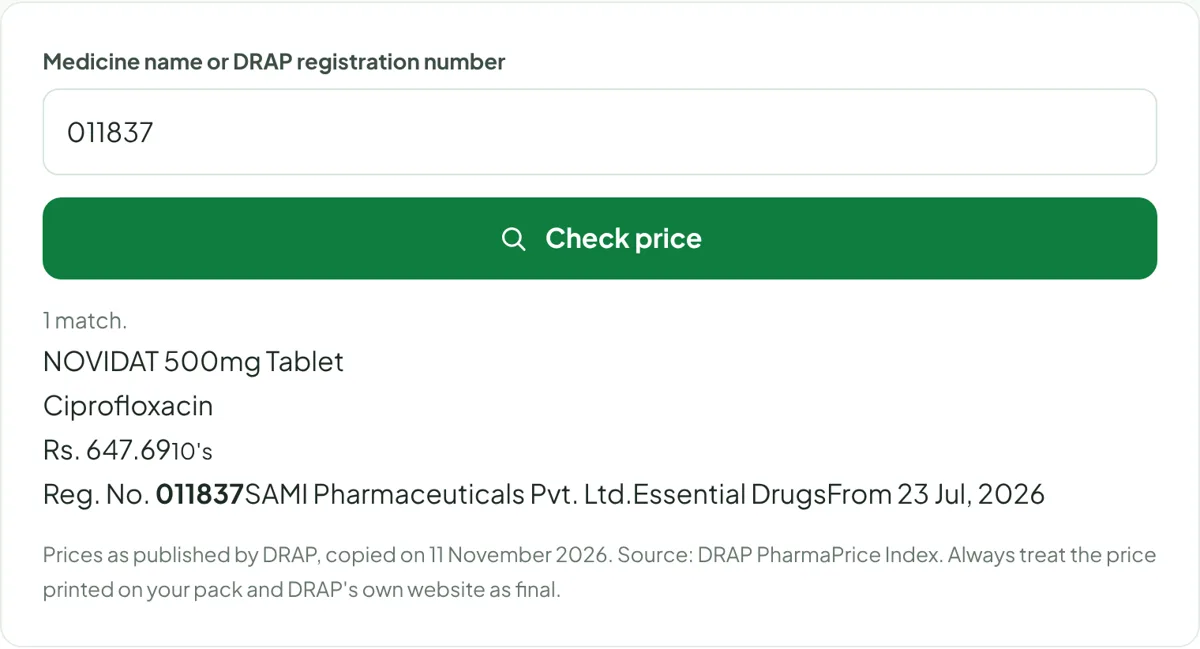
It is the number DRAP assigns when it approves a product for sale, printed on the pack as "Reg. No.". It identifies the product and its registration holder. You can look one up in our DRAP price and registration search.
Does DRAP regulate herbal and nutritional products?
Yes. DRAP has a division for health and over-the-counter products, which covers herbal, homeopathic and nutritional products. These are enlisted under their own rules and carry an enlistment number instead of a drug registration number.
Is DRAP part of the Ministry of Health?
DRAP is an autonomous authority that works under the federal Ministry of National Health Services, Regulations and Coordination.
How do I contact DRAP?
DRAP's toll-free number is 0800-03727 and its head office is at the Prime Minister's National Health Complex, Park Road, Islamabad. For complaints, the online complaint form on drugtrace.dra.gov.pk gives you a written record.
DRAP kya hai?
DRAP yaani Drug Regulatory Authority of Pakistan woh wafaqi idara hai jo dawaon ki registration, companies ke licence, qeematon aur quality ki nigrani karta hai. Mehfooz Dawa isi ka track and trace program hai.
Who heads DRAP?
DRAP is led by a Chief Executive Officer and governed by a policy board under the DRAP Act, 2012. Circulars, such as the 8 October 2026 notice on barcoding, are issued with the CEO's approval.